




Practical evaluation guide

What is a logic model? Development, examples and templates for evaluation practice

A practical explanation of logic models, their relationship to outcomes, how to develop them, examples, common mistakes and template use.

Map the pathway from resources to change

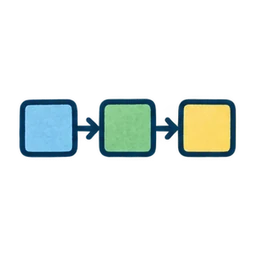
The arrows represent hypotheses about how results may arise.

This guide uses a five-element framework. Drawing the diagram does not, by itself, demonstrate an effect. Read the full explanation

Main takeaway

A logic model is a diagram linking a program's resources, activities, direct outputs and changes in people or organizations to represent hypotheses about how outcomes arise. Its structure can be adapted to the purpose. Drawing the diagram alone does not demonstrate an effect; use it as a basis for considering indicators and evaluation questions. [1]

Use a logic model to check with stakeholders how the program is expected to lead to outcomes. In grant-funded programs, municipal policies, training and nonprofit programs, setting out expected changes and assumptions on one page makes it easier to discuss what needs to be checked.

However, an incorrectly developed model can become merely an activity list or an attractive diagram. It is important to put changes for the target group, rather than activities, at the center.

Build a logic model

Check the elements, work backward from the desired change, and review the assumptions.

The 5 elements used in this guide

This guide organizes the model into inputs, activities, outputs, outcomes and impact. This is one possible approach. Inputs are resources; activities are what is done; outputs are products and services; outcomes are expected changes; and impact refers to broader significant effects. Some models instead describe short-, medium- and long-term outcomes.

Be careful not to confuse outputs and outcomes. For example, holding 10 seminars is an output, while participants becoming able to design evaluation indicators in their own organizations is an outcome.

Sources differ in where they place changes in knowledge and skills. The OECD's 2023 glossary includes changes in knowledge and skills directly produced by activities within Outputs. This site's examples treat learning after training as a short-term outcome, but explicitly follow the terminology and forms required by the recipient.

  • Inputs: personnel, budget, materials, venue and time
  • Activities: training, ongoing support, research, consultation and outreach
  • Outputs: delivery counts, participant numbers, products and distribution counts
  • Outcomes: changes in knowledge, attitudes, behavior, relationships and conditions
  • Impact: significant higher-level positive and negative effects, including unintended effects
[1] [2]

One development approach: work backward from desired change

Here we propose working backward from what should change and for whom. Work back through intermediate changes, initial changes, outputs, activities and inputs, then check feasibility in practice. For an existing program, you may also start from current activities and check in both directions.

Once complete, read each arrow aloud as "If A happens, B should happen." Where this feels wrong, there is a causal leap or a missing assumption.

  1. Define the target group and final outcome
  2. Place intermediate outcomes that lead to the final outcome
  3. Organize outputs as direct results of activities
  4. Check the activities and inputs that produce outputs
  5. List assumptions and external factors
  6. Assign evaluation indicators to what you want to measure
Practical framework or suggestion

Example: a training program logic model

The following is a fictional example for illustration. For evaluation training, the activity is conducting exercises; the output is 12 participants submitting draft plans; the initial outcome is being able to explain the relationship between questions and indicators; the medium-term outcome is agreeing on data collection items at work; and the long-term outcome is using evaluation results to improve the program.

Satisfaction alone does not establish use at work. This example tracks use in meetings after training. Align checks with meeting schedules and opportunities for practice, and record barriers to use, including in relation to time and supervisor cooperation.

Practical framework or suggestion

Common mistakes and corrections

Many reasons logic models fail concern the specificity of wording and insufficient stakeholder agreement, rather than the beauty of the diagram. Outcomes that are too abstract are particularly difficult to translate into evaluation indicators.

Expressions such as "the community becomes more active" or "awareness increases" are difficult to measure on their own. Specify who will begin to take which actions and in what situations.

  • Do not mix activities and outcomes
  • Describe outcomes as changes for the target group
  • Match long-term outcomes to the scale of the program
  • State external factors outside the main diagram
  • Connect the completed model to evaluation indicators
Practical framework or suggestion
Fictional example; not actual results

Connect training to agreement at work

A fictional example for illustration: evaluation planning training for 12 nonprofit staff members.

StageExample entryRecords to check
Output12 people submit draft plansSubmission records
Short-term outcomeCan explain how questions and indicators correspondExplanations during exercises and revision history
Medium-term outcomeAgree on data collection items at the next workplace meetingMeeting records checked within the scope of consent
AssumptionTime for discussion and decision-making authority are available at workCheck with participants and supervisors

What this example supports

Distinguish submission counts from use. If plans are submitted but not used in meetings, check whether the problem concerns the materials or opportunities to practice.

Common errors in judgment

Connect training directly to improvement across the whole organization

How to revise: Include stages for draft plans, workplace agreement, data collection and improvement decisions

Reason: This checks the program's reach and where the pathway might be interrupted.

Submit the completed diagram as evidence of effects

How to revise: Label the diagram as a hypothesis and separately specify records and comparison methods for testing it

Reason: Drawing a causal relationship differs from checking it in reality.

Put it into practice next

Write one output and one change for your program and check the assumptions between them

Frequently asked questions

How does a logic model differ from a theory of change?

A logic model diagrams relationships between activities and outcomes and can also represent a theory of change. Rather than applying a uniform boundary, distinguish them by the change pathways shown and how fully assumptions and evidence behind arrows are explained.

Who should help develop a logic model?

Involving frontline staff, managers and, where possible, beneficiaries and relevant organizations alongside program staff produces a model closer to reality.

Can a logic model alone demonstrate effects?

No. A logic model organizes causal hypotheses. Investigating effects also requires indicator design, data collection, comparative design and other elements.

References and checked sections

  1. CDC Program Evaluation Framework, 2024
    Centers for Disease Control and Prevention · 2024
    Section consulted
    Step 2: Describe the Program
    How it relates to the text
    Models linking activities, outcomes and assumptions, and revision according to circumstances
    Source checked: (includes AI cross-checking)
  2. Glossary of Key Terms in Evaluation and Results-Based Management for Sustainable Development (Second Edition)
    OECD · 2023
    Section consulted
    Outcomes / Outputs (main text, p.45)
    How it relates to the text
    Definitions of outputs and outcomes, and differences between frameworks in classifying changes in knowledge and skills
    Source checked: (includes AI cross-checking)
Content updated: Source checked: (includes AI cross-checking)No documented human reviewIncludes fictional examplesEditorial policy and scope of checkingCite this pageReport a correction

How to cite this page

EvalCompass Editorial Team. “What is a logic model? Development, examples and templates for evaluation practice”. EvalCompass, updated 2026-10-07. https://evalcompass.jun-nakatani.com/en/guides/logic-model/
Add the date you accessed the page. Text created by this site is available under CC BY 4.0. Quotations, external materials, and bundled fonts have their own terms of use. When reusing content, credit the source, link to the license, and indicate any changes.

Suggest a correction or improvement to this page

Change history
  • — A cross-guide review clarified indicator formats, outcome classifications and causal judgments, interpretation of tables, and the scope of SVI2026 where relevant.
  • — Added terminology sources and scope, fictional completed examples, and examples of corrections to mistaken judgments.