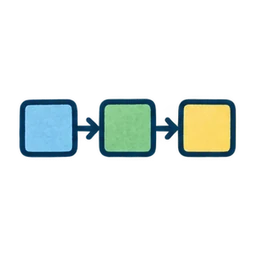
A diagram that links a program’s resources, activities, direct outputs and changes for participants, setting out the assumptions about how outcomes will occur and what needs to be checked. Completing the diagram does not, by itself, demonstrate a causal effect.
Find methods
Find methods that fit your setting using keywords and filters.
A method for making explicit the desired change and the pathways and assumptions leading to it. It sets out, as testable hypotheses, why implementing activities is expected to produce outcomes.
Focus the judgments an evaluation needs to make into questions linked to users’ decisions. Before drafting survey items, decide what the evaluation must answer.
Specify the desired change through definitions, sources, collection methods and timing. Check not only indicator values but also what they represent and what they do not.
A planning and monitoring table linking each level of objectives to indicators, verification sources and external conditions. It identifies what is needed to move from activities to outcomes.
Before evaluation begins, examine the program description, available information and intended uses to determine what kind of evaluation would be credible and useful.
Identify people affected by the program or evaluation and consider engagement suited to their interests, roles and influence. Include people whose voices are seldom heard, as well as decision-makers.
A table linking evaluation questions, judgment criteria, required information and collection and analysis methods row by row. It reveals items that cannot answer the questions and information that would be collected but not used.
An assessment table linking what is evaluated to concrete conditions at each performance level. It communicates the reasoning that connects evidence to judgments.
A framework for prioritizing questions needed for decisions and planning evidence collection and use to answer them. It links what to learn, decision timing and responsibility.

Examine program value through 6 perspectives: relevance, coherence, effectiveness, efficiency, impact and sustainability. Define questions and priorities according to the evaluation’s purpose.
A framework examining context, inputs, process and outcomes separately to support decisions from planning through implementation and improvement. It considers what should improve as well as whether outcomes occurred.
Evaluation frameworks
Kirkpatrick Four-Level Training Evaluation Model
Kirkpatrick Four-Level Training Evaluation Model
A framework distinguishing reaction, learning, behavior and results to examine training and workplace outcomes. Work backward from desired results to design learning and workplace support.
An approach that clarifies who will use evaluation, for which decisions and when, then selects questions and methods based on that use. It plans use beyond reporting.
Evaluation that supports adaptation during development of an uncertain program through frequent information gathering and reflection. Record what was tried, learned and changed in decisions.
Examine for whom, under what circumstances and why change occurs through hypotheses linking context, mechanisms and outcomes. Explore why the same program produces different results.
An approach in which participants evaluate their own goals, current conditions and improvement plans while developing capacity to continue evaluation. Evaluators support them as collaborators who question the evidence.
An evaluation approach that examines actual changes and unexpected harms without preconceptions from stated program goals. It provides a perspective distinct from goal achievement.
Investigate cases with strong and limited outcomes in depth to identify enabling conditions and barriers. Its purpose differs from estimating representative average effects.
A management approach that plans from desired results, gathers information during implementation and uses it for judgments and adjustments. It distinguishes activity volume from changes for participants.
An evaluation that focuses questions, populations and methods around a short decision deadline, iterating collection and analysis to produce actionable findings. State the limitations accompanying speed.
Evaluates how program opportunities, reach, benefits and burdens differ across groups, focusing on conditions creating exclusion or disadvantage. It also plans participation by people likely to be left behind.

A method of collecting experiences, behavior and attitudes using common questions. Alongside clarity, record who received the questionnaire and who responded to judge the scope represented by results.
A method of eliciting specific experiences and reasons for judgments through dialogue. Define question structure and selection rationale, and interpret statements with their context and interviewer influence.
A group interview identifying shared experiences and differing opinions through participant dialogue. Facilitators balance participation and record mutual reactions less visible in individual interviews.
Directly records behavior and events in practice. Define situations and items and retain observed facts separately from interpretations.
Systematically reads plans, minutes and implementation records to extract information needed for evaluation questions. Check purpose, versions and what is not recorded too.
A research design examining particular people, organizations or programs in depth and context. Combines sources to examine events and the validity of explanations.
A participatory method in which participants use their photographs to express strengths and problems in daily life in their own words. Photographers select and interpret images and discuss improvements.
Participants or staff continuously record events and insights to trace everyday change and processes. Adjust frequency and burden and distinguish unrecorded days from days without events.
Uses statistics or operational records collected for another purpose in evaluation. Check fit of collection purpose, targets, definitions and timing to evaluation questions.
Residents and stakeholders map and discuss local resources, access routes and difficulties. Organizes place distributions and service-access conditions from residents' perspectives.

Randomly assigns targets to intervention/comparison groups and compares outcomes to estimate effects. Check attrition, non-compliance and between-group influences after assignment.
Estimates effects by subtracting before/after change in the comparison group from that in the intervention group. Assumes parallel changes without intervention.
Estimates participation probabilities from observed pre-intervention characteristics and compares matched targets with similar probabilities. It cannot resolve unobserved confounding or lack of comparators.
Uses schemes where assignment changes at a continuous indicator's threshold to compare nearby outcomes. Estimates a local threshold difference, not automatically generalizable to distant targets.
Uses continuous before/after series to estimate changes in outcome level or slope. Consider seasonality, autocorrelation and concurrent changes.
Weights several unexposed areas or organizations to create a comparator resembling the treated unit's past trends. Pre-fit and donor suitability matter.
Examines how programs contribute to outcomes through theory of change, multiple sources and alternative explanations. Explains pathways and remaining uncertainty.
Tests evidence for causal pathways within one case by hypothesis. Considers not just event order but how well evidence distinguishes competing explanations.
Compares combinations of conditions and outcomes across cases. Calibrates set membership with evidence and distinguishes necessary from sufficient conditions.
A research framework evaluating effects through intervention differences produced by policy changes or institutional events whose assignment researchers do not control. Assignment processes and valid comparisons are central.

Collects stories of change, selects those considered important with reasons, and enables stakeholder learning. Selection and feedback are essential stages.
Works backward from changes that actually occurred to examine program contribution. Includes unexpected changes and emphasizes substantiation by independent sources.
Focuses on changes in directly engaged partners' behavior and relationships, organizing signs of desired change and support strategies. Distinguish activities under your control from areas where you influence partners.
A dialogue approach exploring successful experiences and their enabling conditions, connecting them to desired futures and concrete actions. It investigates strengths for improvement.
Participatory & qualitative approaches
Participatory Rural Appraisal / Participatory Learning and Action
Participatory Rural Appraisal / Participatory Learning and Action
A participatory approach in which local people analyze their circumstances and connect findings to planning and action. Outsiders support tools and dialogue while learning local knowledge.
A panel responds to several surveys and revisits judgments after receiving aggregated opinions and reasons. Report remaining differences as well as agreement levels.
Organizes group priorities through individual idea generation, round-robin sharing, clarification and individual ranking. Reduces influence from louder voices.
Small groups discuss questions, connect ideas while changing tables, and share insights with the whole group. Question design and final sharing are central.
Participants learn from multiple sources and perspectives and develop recommendations on public choices through deliberation. Design selection, information balance and response arrangements.
A method in which stakeholders discuss factors and connections to map a system, organizing different perspectives, possible interventions and questions for evaluation.

Analysis & synthesis
Descriptive Statistics and Cross-tabulation
Descriptive Statistics and Cross-tabulation
Summarizes data distributions using frequencies, percentages, means and medians. Show units, denominators and missingness, and avoid describing the whole distribution through one summary statistic.
Models relationships between outcome and explanatory variables. Distinguish prediction, description of associations and effect estimation, and check models and assumptions suited to the outcome type.
Develops themes as patterns of meaning relevant to the question through close reading of narratives or open responses. State the analytical approach and explain links between themes and source data.
Classifies text or records into common categories to examine concepts' presence, frequency and relationships. Specify units and code definitions and link findings to originals.
Combines quantitative and qualitative data and integrates findings to answer questions. Design where and how they connect rather than merely collecting both types.
Systematic review searches, selects and appraises research against explicit criteria. Meta-analysis statistically combines effect estimates from studies suitable for synthesis.
Represents people or organizations as nodes and referrals, collaboration or information sharing as edges to examine connection structures. Define who is included and what counts as a tie first.
Compares outcomes or work processes with suitable benchmarks to identify improvements. Examine conditions behind differences and transferable practices as well as rankings.
Communicates numerical comparisons, trends and distributions visually. Select charts suited to questions and show axes, units, denominators and sources to reduce misreading.
Processes text as words or documents to examine frequency and co-occurrence patterns. Record units and preprocessing and interpret findings against source texts.
Systematically searches and classifies research to display where evidence exists and is missing within a framework such as interventions and outcomes. Distinguish this from conclusions about effects.
Combines location and area characteristics to examine distances to services and differences in reach between areas. Align map design and aggregation units with the question.

A method for comparing alternatives' costs and benefits in a common monetary unit. Align the analytical perspective and period, and report present values alongside impacts that cannot be monetized.
A method for comparing the costs and effects of alternatives using a common outcome unit. It examines additional effects relative to additional costs without converting outcomes in natural units into monetary values.
An economic evaluation that combines health-related quality of life and survival in measures such as QALYs and compares them with costs. Align scales, valuation, periods and comparators, and examine additional cost per QALY.
A method for organizing changes experienced by stakeholders and relating monetized value to inputs. Adjust for changes that would occur without the program and others' contributions, and disclose assumptions and sensitivity.
A method for judging the value obtained from resources through economy, efficiency, effectiveness, equity and other dimensions. Evaluate quality and who is reached as well as low costs.

Links the evaluation questions, methods, findings, conclusions and recommendations in a form readers can use to make decisions. It also presents limitations and sources so readers can trace the evidence behind conclusions.
Examines the quality of an evaluation itself against selected standards and evidence. It supports improvements at the design stage and checks the credibility of completed evaluations.
Continuously measures defined indicators against baselines and targets to inform operational decisions. Tracks changes in outcomes as well as counts, with consistent numerical definitions and collection responsibilities.
Organizes strategic objectives through perspectives such as finance, users, internal processes, and learning and growth, linking indicators and actions. Nonprofit organizations adapt perspectives and relationships to their mission.
Records the organization's position on recommendations and its reasons, planned responses, responsibilities and deadlines. Makes decisions and progress after receiving the report traceable.
Reporting, use & meta-evaluation
Evaluation Dissemination and Communication
Evaluation Dissemination and Communication
Designs opportunities to deliver findings to those who need them, discuss their meaning and use them in decisions. Determines content, format, timing, channels and responsibilities for each readership.
Develops people's skills, organizational arrangements and an environment supporting learning so evaluation informs everyday decisions. Provides time and responsibilities for practical use alongside training.
Checks evaluation purposes, procedures, ethics, information accuracy and accountability against standards. Records evidence of problems and improvements rather than relying on total scores alone.
Examines dignity, voluntary participation, information handling, conflicts of interest and honest reporting in concrete terms. Reviews these according to circumstances from design through publication.
Reporting, use & meta-evaluation
Implementation Fidelity Assessment
Implementation Fidelity Assessment
Checks how far an intervention was delivered as planned in content, frequency, duration and reach. Delivery quality and participant responses also inform outcome interpretation.
Add up to three methods to compare.
Compare candidatesDifficulty, cost, and duration are editorial estimates. Adjust the illustrative schedules to your program’s scale and capacity.

What to check when choosing a method
Difficulty, cost, and duration are editorial estimates. Read each method’s unsuitable situations, conditions and evidence, and completed example to judge whether it fits your questions, data, and resources.
Compare candidates side by side
How to cite this page
EvalCompass Editorial Team. “Find methods”. EvalCompass, updated 2026-10-09. https://evalcompass.jun-nakatani.com/en/methods
Add the date you accessed the page. Text created by this site is available under CC BY 4.0. Quotations, external materials, and bundled fonts have their own terms of use. When reusing content, credit the source, link to the license, and indicate any changes.
Change history
- — Added filtering by purpose alongside category, difficulty, cost, and search.
- — Improved page-specific lightweight data, sharing search filters, and restoring search history.
- — Improved duration, difficulty, and cost labels, search spelling variants, and restoration of search filters.
- — Reviewed definitions, conditions of use, and document-level references for all 79 methods, and updated the library.